P0441/P0443 Evap System Codes

guyslp

Junior Member
Joined
Feb 25, 2013
Messages
41
Reaction score
8
Points
8
Location
Staunton, VA
Buick Ownership
1996 Buick Roadmaster Estate Wagon Collectors Editon
I do know already what these are in reference to, but what I cannot seem to find anywhere is a good illustration of the exact routing of the hoses to and from the charcoal cannister that resides forward of the right front wheel well cover.

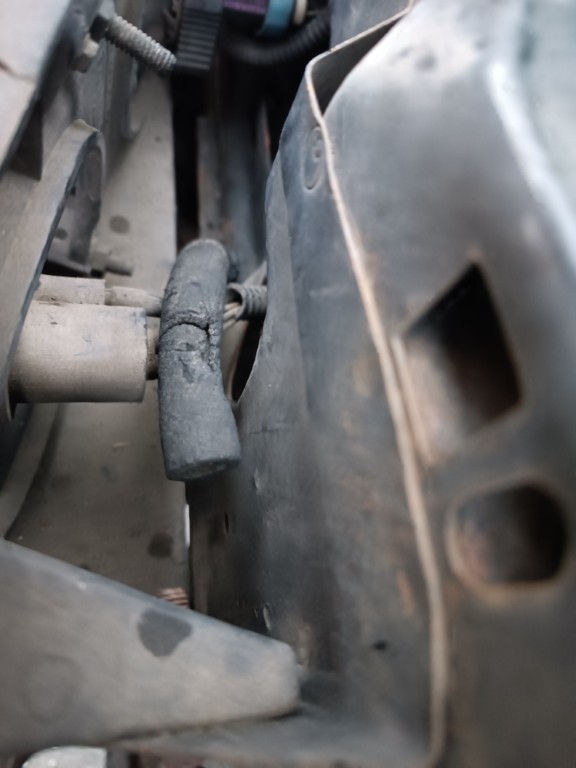
These hoses (unsurprisingly) are in marginal shape after all the years they've been in service, and what they're made of kinda reminds me of the sort of insulation you find on AC hoses, but thinner. They're all chalky and as you'll see, my one mystery hose is broken with holes in a couple of places. This mystery hose, in its current positioning, threads up from the cannister behind the headlight, and then hangs there in mid-air. Looking at the end of the hose (photos below) it certainly seems as though this thing was once on a barb or just a plastic tube connection ever so slightly larger in its outer diameter than the inner diameter of the hose, for a friction fit.

What I cannot figure out is whether where it is now is anywhere near to where it's supposed to be. If the thing it connects to is "up top somewhere" it would seem that it should be on the other side of the hole in the radiator support, but I can't find anything at all in that area.

I would love to have an illustration of what hoses go where in this system, as well as information regarding exactly what hose type I should be purchasing as replacement. I've got silicone vacuum hosing, but this stuff does not appear to be anything like silicone.

Any advice is really appreciated, and here are photos of the top end of that mystery hose where you can see it. The other end is connected to the charcoal cannister.
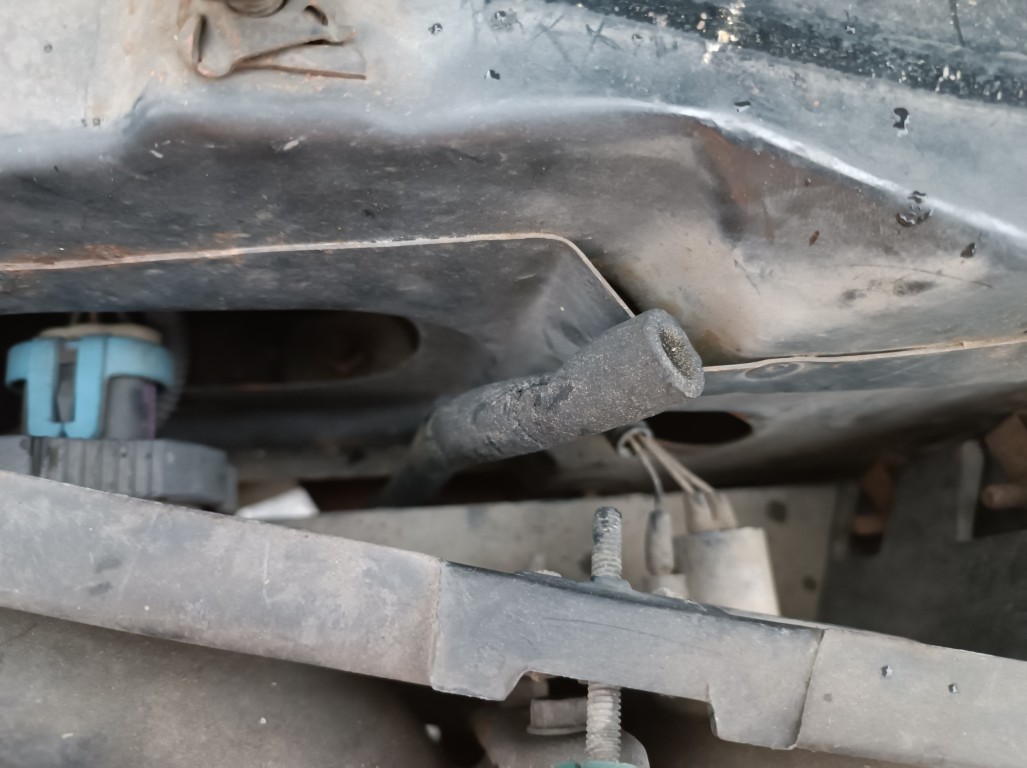
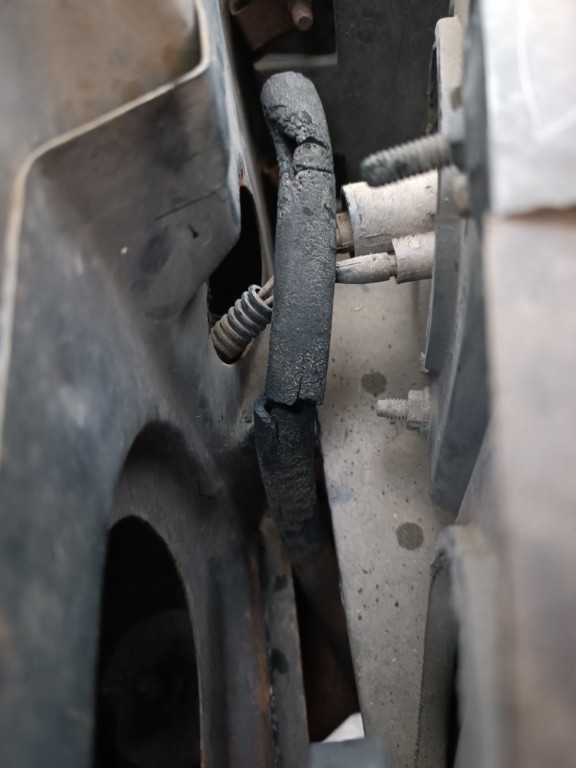
01_Evap_Hose.jpg
02_Evap_Hose.jpg
03_Evap_Hose.jpg
 
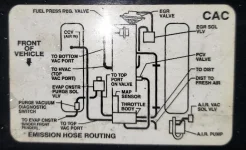
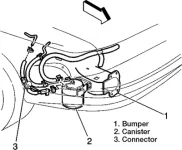
Do you not have a vacuum diagram on the radiator shroud/cover? From the diagram, (posted below) it appears that rotten hose you are showing is the vent to atmosphere & goes nowhere else when the engine is off. You must have a vent control solenoid problem, or another vacuum line from the canister.
1746334055367.webp
 
Last edited:
I don't have anything like that diagram that I've ever noticed, though now I will take a look again. And I've been under that hood enough over the years that I think I would have.

I have purchased the replacement parts (CP208 and CP112) and know where these are located, but because I have been unable to locate something like you've just kindly posted, I was uncertain about hose routing.

I figure if I'm going to bother with this project I had might as well replace the hoses while I'm at it, so now I need to determine what hose type it is I need to get and grab enough to cut the various segments to length.

I feel like a bit of an idiot here, but how can you tell anything about the connections to/from the evap cannister from this diagram? I see the "to evap cnstr" bit here, but nothing further. That thing, while not literally like an octopus, seems to have several hoses attached to it, at least 3. I've got the car up on ramps and since it's not raining today I'll have to take a closer look again.
 
Last edited:
@ulycyc

Thanks very much for the recommendation of the Operation CHARM online service manuals. I have recommended them myself many times.

I had already looked in these and my "searching mojo" still didn't turn up any diagrams/illustrations for what I'm looking for.
 
@ulycyc

Kinda, sorta. I'll post photos here, and there are definitely 2 lines going in to the evap cannister, but it shows nothing for any vent from the cannister to the atmosphere (which is what I thought was trying to be avoided in the first place).

My guess is that I'm just going to have to trace the various flex hoses as best I can.


These two lines are "incoming" to the evap cannister:

IMG_20250504_163709 (Medium).webp

Top of the evap cannister where those two lines come in:
IMG_20250504_163658 (Medium).webp

I cannot get a good shot of the single hose on the opposing side, and it definitely does come off of the evap cannister and is the one that I previously showed the top end of that's in mighty rough shape.

@HotZ28 : That diagram you posted is indeed on top of the radiator shroud. It just didn't register for me over the years.
 
From the Chilton manual for the '96 Roadmaster.

The Evaporative Emissions (EVAP) Canister is the primary component in the Evaporative Emission (EVAP) Control System that prevents the evaporation of unburned fuel vapors (Hydrocarbons) from being released into the atmosphere. The EVAP canister contains a charcoal element for the filtering of hydrocarbons, and the filtered Carbon Dioxide (CO2) is then vented to atmosphere when the vehicle is not in operation. The canister also contains a number of ports, which provide for the redistribution of hydrocarbons into the fuel tank when the vehicle is in operation through the purge control system.
1746416384874.webp

Evaporative Emission (EVAP) Pressure Control Valve​

With a hand vacuum pump, apply approximately 51 kPa (15 in. Hg) to the control vacuum tube. After ten seconds, there should be at least 17 kPa (5 in. Hg) vacuum remaining. Be sure the hand vacuum pump being used does not have an internal leak and the hose connections to control vacuum tube and pump are secure. If after 10 seconds there is less than 17 kPa (5 in. Hg) vacuum, the valve must be replaced.

With 51 kPa (15 in.  Hg) vacuum still applied to the control vacuum tube, attach a short piece of hose to the valves tank tube side. Blow into the tube. You should feel the air pass through the valve. If air does not pass through, the valve must be replaced.
 
Last edited:
______________________________

Help support this site so it can continue supporting you!
This repair is driving me to drink!!

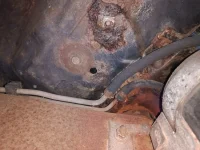
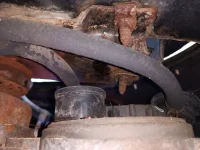
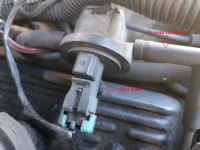
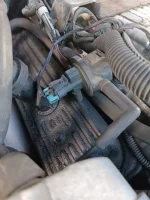
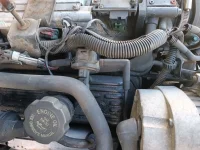
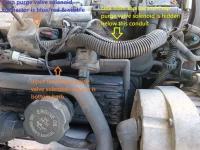
First, the evap cannister is located, so that's no problem. But now what I can't seem to locate is the purge valve solenoid. In the position that I thought was for the purge valve solenoid is what is shown as the Purge Valve Sensor in the CHARM manual. Here are the pictures of this in my car:

01_Existing_in_Situ (Medium).webp

02_In_Situ_Long_Shot-1 (Medium).webp

03_In_Situ_Long_Shot-2 (Medium).webp

From what I can determine from both the CHARM manual and other reading, this is NOT the thing that causes a P0441 or P0443 to be thrown. Also I can't seem to find this thing under the name the CHARM manual gives it on several different parts sites.

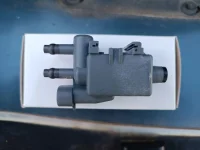
Everything I've read suggests that the problem most likely culprit is the purge valve solenoid. That is what I ordered, and this is a photo of what I got:

IMG_20250506_172151 (Medium).webp

I cannot seem to find this thing anywhere in the CHARM manuals and I've searched for "everything EVAP" and cannot find a single illustration of the part, nor an illustration of where in the world it is under the hood.

I had also purchased a evap check valve, which I now really doubt I need at all.

If there's something useful in the Chilton manual with regard to the above pictured EVAP purge solenoid and its location, please share.

I've been doing DIY wrenching for years, and on cars more exotic than a Buick, but have not had as much trouble finding the reference materials I need, particulary in regard to component locations.
 
Well, again, and much to my relief, I found this page:

CHARM page on Purge Flow Sensor: Service and Repair

Even though it's not directly indicative of where that solenoid is, it gives a strong hint, and I found it nested beneath the large metal bracket that the large air resonation chamber that sits on top of the engine is mounted on. I had taken that resonator out, so could eventually see it. The fun will be getting the thing out and the new one back in.
 
Well, still no joy. Although I definitely located the evap purge valve solenoid, I cannot for the life of me figure out how to extract it, and it's very hard to see beneath the bracket it's hiding beneath.

03_In_Situ_Long_Shot-2 (Medium).webp

I decided it's time to walk away for a while, but not before removing the lines connected to the evap purge valve solenoid and giving it a good spritz of WD40 in both ports. I have had any number of solenoids become sticky that were successfully un-stuck, and stayed that way, by giving them a heavy duty dose of WD40 or equivalent and letting it soak for a day or two.

I'm going to reset the code(s) then watch if they come back. If so, then it's back to figuring out how to get this thing out and get its replacement installed. But right now it's frustrating me too much, and I know that I will break something if I don't walk away and let things tumble around in my mind about how to approach things on the next try.
 
Back
Top