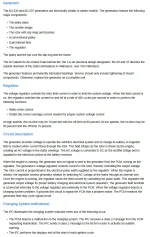
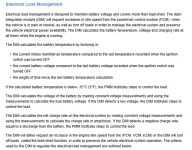
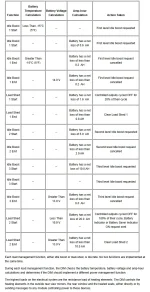
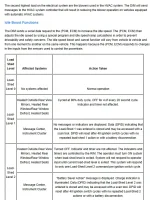
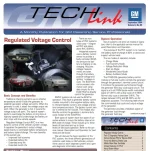
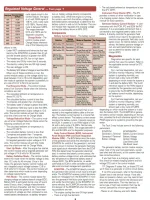
Attached is the charging circuit schematic for the 2000-2005 Buick LeSabre. Below is a summary for the charge circuit control-scheme used on the 2000-2005 LeSabre.
The 2000-2005 Buick LeSabre uses a PWM (Pulse Width Modulation) signal between the PCM (Powertrain Control Module) and the alternator to enable variable voltage charging, allowing the PCM to precisely control the battery's charging voltage (Vset) for better battery health, optimal engine efficiency (by reducing alternator drag), and system management, rather than a fixed voltage. This PWM signal, a series of 5V pulses at ~128Hz, tells the alternator's internal regulator how much to charge, with longer "on" times meaning higher voltage, adapting to battery needs and electrical load.
How it Works:
PCM Senses: The PCM monitors battery voltage, electrical load, engine RPM, and alternator output.
PCM Calculates: It determines the ideal charging voltage (Vset) for current conditions (e.g., colder battery needs higher voltage, heavy loads need more power).
PCM Commands: It sends a PWM signal (duty cycle) to the alternator's field circuit.
Alternator Responds: The alternator's regulator interprets the duty cycle (percentage of "on" time) to adjust the magnetic field strength, thereby changing the output voltage.
One closing point: All supporting GM literature indicates that (on the Lesabre's) the PCM handles the charging I/O (Feedback, PWM Output & Charge Permissive) and the closed loop logic. However I <suspect> the closed loop logic 'might' reside in the Dash Integration Module (DIM), but I'm not yet certain if this is the case. Regardless, the information between the (2) modules is via the class-2 J1850vpw bus and the real-time charge voltage is then passed from the DIM to the IPC to be displayed (for DIC equipped LeSabre models) also via the class-2 J1850vpw bus.