Exhaust leak fix? - Buick Lesabre 02 95k with ticking noise

chibuick

Active member
Joined
Oct 30, 2023
Messages
101
Reaction score
66
Points
28
Buick Ownership
1996 Park Avenue, 1995 Park Avenue, 2002 LeSabre Custom
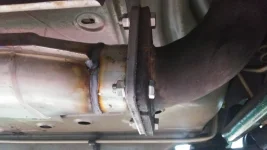
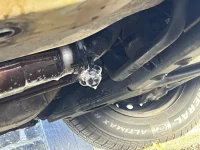
I found an exhaust leak on the mid pipe before the catalytic converter using the vacuum-in-tailpipe and soapy water method (photo attached). There was no leak in the front exhaust manifold but I couldn't check the rear exhaust manifold. The car also has a ticking noise as I accelerate while driving but not when idling or accelerating in park/neutral. It sounds similar to how a bicycle with gears sounds while coasting but not pedaling (can't think of another comparison).

I understand that exhaust leaks can sometimes cause ticking sounds on acceleration, but would appreciate any input on how to best fix that leak and/or what else might cause the ticking sound and how to diagnose. Thanks!
1699991225389.webp
 
Looks like you need a gasket at the flange for the converter. Has it been replaced prior to you owning it?
Any decent muffler shop should be able to handle the job.
 
Looks like you need a gasket at the flange for the converter. Has it been replaced prior to you owning it?
Any decent muffler shop should be able to handle the job.
The seller told me he put in a new catalytic converter and O2 sensors so I’d imagine a new gasket at the flange but not sure. Any idea why I seem to only hear it when I’m actively driving the car and not idling?
Thanks.
 
The seller told me he put in a new catalytic converter and O2 sensors so I’d imagine a new gasket at the flange but not sure. Any idea why I seem to only hear it when I’m actively driving the car and not idling?
Thanks.
Because the torque flexing of the engine is working against the exhaust hangers and causing the void to be opened and the engine is also making more noise since it’s working harder. The issue could have been caused by no new gasket, not properly suspending the exhaust in the hangers, and poor torque, or rust. That appears to be VERY clean for a 2002 oem so that’s awesome. I would take a pic of your exhaust hangers at the rear and anywhere else they are in your tailpipe, and show us
 
______________________________

Help support this site so it can continue supporting you!
Because the torque flexing of the engine is working against the exhaust hangers and causing the void to be opened and the engine is also making more noise since it’s working harder. The issue could have been caused by no new gasket, not properly suspending the exhaust in the hangers, and poor torque, or rust. That appears to be VERY clean for a 2002 oem so that’s awesome. I would take a pic of your exhaust hangers at the rear and anywhere else they are in your tailpipe, and show us
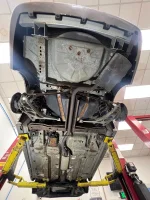
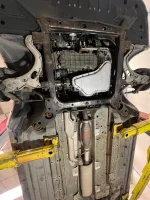
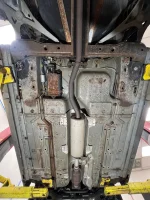
I would never have thought the torque flexing and hangers would impact that joint, but makes sense. I don't have any pics of the hangers themselves right now but have a few underside photos where you might be able to tell. I'll try to get some better photos tomorrow. It's got some surface rust on it and I've cleaned off what I could.
 

Attachments

  • IMG_9359.webp
    IMG_9359.webp
    241 KB · Views: 21
  • IMG_9361.webp
    IMG_9361.webp
    294.2 KB · Views: 22
  • IMG_9360.webp
    IMG_9360.webp
    297.3 KB · Views: 21
I cant see close enough to tell for sure but it appears you may be missing a rivet in the heat shield for the oxygen sensor wiring near the cat converter. It appears to be an empty hole , or it could be dirt/gunk over the rivet head (or a hole where one should be) that could cause ticking especially if the harness pushes on it as the exhaust moves. I cant see the hangers perfectly but the entire exhaust appears to be pushing backward toward the rear of the car. the exhaust should hang freely straight down, those rubber hangers seem to have quite a good amount of swing going on them. if thats true, your exhuast is likely grounding out or similar.

heres a FSM tidbit
"The transfer of rattles and noise vibrations in the exhaust system can be caused by misalignment of parts or retention of heat shields. When aligning the exhaust system, leave all the bolts or nuts loose until the parts are properly aligned, then tighten the bolts and nuts working from the front to the rear of the vehicle."
1700010862473.webp
1700010881762.webp
 
I would never have thought the torque flexing and hangers would impact that joint, but makes sense. I don't have any pics of the hangers themselves right now but have a few underside photos where you might be able to tell. I'll try to get some better photos tomorrow. It's got some surface rust on it and I've cleaned off what I could.
It appears there may be a welded in area between the cat and the resonator. if that is what it pushing your exhaust outward and cannot be fixed by adjusting things, you may need to hack off a short bit of pipe to get it back to the right length. Im basing that on the appearance of the pipe between the sensor and the resonator, it looks like it may have been welded on by a shop.

If its OE, then ignore that. but if you HAVE to remove any pipe to shorten it up, the best place to do that is after the resonator and before the first set of exhaust mounts, in the straight run. i dont advise cutting if you dont have to but just putting that out there for you. I think if you fix the leak and get the exhaust suspended properly it should line up normal.
 
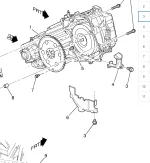
youre also missing a push in retainer on the torque converter dust shield.
1700011551673.webp
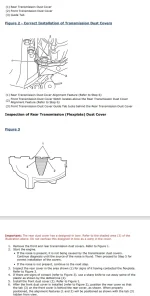
Its #3 in this diagram 11509051 I guess its a plastic or maybe metal bolt that holds the two covers and that transmission cooler line hold down bracket. It was likely lost when someone replace the cooler lines in the past(they dont look OEM)

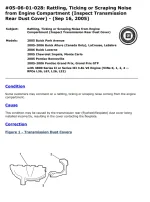
The cover being lose is a known cause of noise on acceleration and the lines being unsecured are also able to cause noise on acceleration because they will vibrate and ground out against things like your oil pan, crossmember, and carry pulses of your tranmission fluid which increases pressure and flow when accelerating. It may seem silly but the sounds of those things combined with the vibrations can sound much more amplified being inside the car than you realize. And may be your issue. It could also be a combination of factors.
1700011840215.webp1700011932154.webp
Ignore the year range, the engines had the same plastic cover design for multiple years and the changes made could still have the issue so you can use it as guidance
heres a oily pic from my 1999 L67 (which has the same covers and design as your 2002 L36)
1700012011552.webp
and my bad, that push pin holds the trans cooler lines but the bolt situation is still true in your car
 
______________________________

Help support this site so it can continue supporting you!
I would never have thought the torque flexing and hangers would impact that joint, but makes sense. I don't have any pics of the hangers themselves right now but have a few underside photos where you might be able to tell. I'll try to get some better photos tomorrow. It's got some surface rust on it and I've cleaned off what I could.
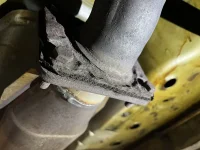
not saying there was not one put in but I cant see a gasket in that flange and the other one looks bent to hell. no one ever takes time to flatten that flange surface out even with a gasket it can only seal so much and a flange that is bent more than a mm it will not seal without using a thicker gasket. over time and heat cycles the edge of flange bends towards the other flange and when gasket get old grimed up with road salts it breaks up and falls out and once the flange has no more room to go towards the other flange each cycle that comes and goes it makes that seal just a little looser each time till finally gasket just falls out . another reason why the flanges bend like that is again gasket breaks up starts leaking then some moron instead of replacing gasket decided to torque bolts down more which just bends them corners over even more and if issue is not corrected when gasket is replaced it either will not last long or not seal at all.
 
pic is from my cat replacement 4 years ago still no issues cause 1 I made sure my flange was still flat and 2 I do not think yours is the factory flange it looks like a stamped flange replacement see how thick mine is or course could be wrong on flange thickness your image is not a close up shot so not a real clear view0814190700 (2023_01_29 21_20_41 UTC).webp
 
Thank all for this detailed reply. I'll take a better look at BuickGirlFromMars' diagrams on the torque converter dust shield and then later under the car to better understand it. I am relatively new to cars so just taking my time learning. These forums are great and can't tell you guys how much I appreciate the time spent helping me.

And yes, I did realize that O2 sensor coming from the converter is not covered by the heat shield a while ago and made me wonder about how this was affecting the exhaust system. I don't have a lift or jacks currently so it's hard to get under the vehicle to take closer photos. The prior pics I shared were when I rented a lift by the hour for rust removal.

I went to a muffler/exhaust shop today and saw the old gasket loose and paper thin. They recommended I order a new gasket and have them install it in a few days and see how that improves things. BossHog39, great photo. My flange is not as thick as yours for sure, but maybe the new gasket will get me through in the meantime while I have a look at the alignment of the entire exhaust system as well as torque converter dust shield. Will keep you guys posted. Thanks.
 
I was wondering...what would happen if the gasket doesn't work and I decide to just remove the flange before the converter to make the pipe one piece from the engine exhaust manifold down to the cat? What is the purpose of that flange there in the first place, is it just to more easily take apart the exhaust system, less welding, cheaper, etc.? Or is there another mechanical reason that flange should exist?
 
______________________________

Help support this site so it can continue supporting you!
With the proper gasket and bolts your exhaust leak should be fixed.
If the previous converter was replaced due to contamination then you should check that the vehicle is not running “rich” or burning oil. Either of those situations will cause a cat to fail.
 
I was wondering...what would happen if the gasket doesn't work and I decide to just remove the flange before the converter to make the pipe one piece from the engine exhaust manifold down to the cat? What is the purpose of that flange there in the first place, is it just to more easily take apart the exhaust system, less welding, cheaper, etc.? Or is there another mechanical reason that flange should exist?
the flange is because assembling the car is easier when the engine and trans can be dropped in and the exhaust bolted up to it. Other than that, there is not much reason from factory. but I do not recommend removing that flange unless its bad or leaks or breaks replacing the gasket. It also gives strength to the assmebly since it would otherwise be too stiff for just a pipe all the way and would probably try to crack over time.

the o2 sensor not being covered by a heat shield is OK, the thing I was pointing out is the heat shield for the wiring of the O2 sensor. the cat heat shield appears ok and I dont see any missing rivets
 
Thank you for that clarification!
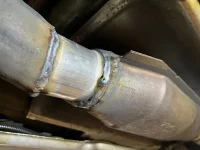
An update for you all - I got a better look at the flange today and realized the front plate was so worn and warped that no gasket would fix the leak, so I opted to have it cut off and welded into a straight piece. Here's some pics:
IMG_9543.webp
IMG_9544.webp

Unfortunately this did not fix the ticking sound I am hearing upon acceleration, so now I'm onto the torque converter dust shield as recommended and also wondering if there might be a leak at the rear exhaust manifold (the 3 that are hard to reach) or at the oval looking flange before the part I cut out today (I got my first look at it today - didn't realize that flange was there).

On the topic of running rich, I checked short and long term fuel trims. STFT are 0-5% at idle. LTFT is consistently at +15% while at idle but drops to near 0% while at 2500rpm. O2 sensors oscillating between 0.1-0.9V. This is possibly a separate issue, but if this indicates I'm running lean, I wonder if that is a symptom of an exhaust leak at the rear manifold or that oval flange causing air to enter the exhaust and be picked up by the O2 sensors and then reading a false lean condition...but then why would the LTFT go down to near 0% when at 2500rpm?

I am trying to see if this symptom can relate to a possible exhaust leak I haven't diagnosed yet and maybe causing the noise I am hearing, or potentially just the torque converter dust shield, or other. Any thoughts are appreciated.
 
I would check to see if the flex joint behind rear manifold if it still on car they are bad to break replaced a couple of them but now that you had that welded its no longer a bolt on deal wwqere.webp
 
______________________________

Help support this site so it can continue supporting you!
a
Thank you for that clarification!
An update for you all - I got a better look at the flange today and realized the front plate was so worn and warped that no gasket would fix the leak, so I opted to have it cut off and welded into a straight piece. Here's some pics:
View attachment 44645
View attachment 44646

Unfortunately this did not fix the ticking sound I am hearing upon acceleration, so now I'm onto the torque converter dust shield as recommended and also wondering if there might be a leak at the rear exhaust manifold (the 3 that are hard to reach) or at the oval looking flange before the part I cut out today (I got my first look at it today - didn't realize that flange was there).

On the topic of running rich, I checked short and long term fuel trims. STFT are 0-5% at idle. LTFT is consistently at +15% while at idle but drops to near 0% while at 2500rpm. O2 sensors oscillating between 0.1-0.9V. This is possibly a separate issue, but if this indicates I'm running lean, I wonder if that is a symptom of an exhaust leak at the rear manifold or that oval flange causing air to enter the exhaust and be picked up by the O2 sensors and then reading a false lean condition...but then why would the LTFT go down to near 0% when at 2500rpm?

I am trying to see if this symptom can relate to a possible exhaust leak I haven't diagnosed yet and maybe causing the noise I am hearing, or potentially just the torque converter dust shield, or other. Any thoughts are appreciated.
On your fuel trims, you should replace your OEM pre-cat o2 sensor (its easy and cheap to do) an old one might be poisoned or just worn. A Delphi or OEM will be high quality. Need a special o2 sensor socket to remove it. Its by the spark plugs on the rear of the engine.

Then at that point, remove your battery cable for 5 minutes or use a scan tool to reset fuel trims and then drive normally for a while, and recheck your trims.

Also worth using some MAF cleaner on your MAF sensor too.
 
Thank you for that clarification!
An update for you all - I got a better look at the flange today and realized the front plate was so worn and warped that no gasket would fix the leak, so I opted to have it cut off and welded into a straight piece. Here's some pics:
View attachment 44645
View attachment 44646

Unfortunately this did not fix the ticking sound I am hearing upon acceleration, so now I'm onto the torque converter dust shield as recommended and also wondering if there might be a leak at the rear exhaust manifold (the 3 that are hard to reach) or at the oval looking flange before the part I cut out today (I got my first look at it today - didn't realize that flange was there).

On the topic of running rich, I checked short and long term fuel trims. STFT are 0-5% at idle. LTFT is consistently at +15% while at idle but drops to near 0% while at 2500rpm. O2 sensors oscillating between 0.1-0.9V. This is possibly a separate issue, but if this indicates I'm running lean, I wonder if that is a symptom of an exhaust leak at the rear manifold or that oval flange causing air to enter the exhaust and be picked up by the O2 sensors and then reading a false lean condition...but then why would the LTFT go down to near 0% when at 2500rpm?

I am trying to see if this symptom can relate to a possible exhaust leak I haven't diagnosed yet and maybe causing the noise I am hearing, or potentially just the torque converter dust shield, or other. Any thoughts are appreciated.
also if you havent bought a replacement bolt for your torque converter dust shield yet, you can remove them to diagnose the issue (you can safely drive with them off for a temporary time)

If you do that, I would like you to examine your flex plate on your torque converter and the teeth on the outer part of it. With the dust shields off and the car on jacks or on a lift, you should be able to shine light and a camera into the opening and inspect them for damage. if you dont know what you are looking at, you can send us pictures and we can tell you if there are any issues. That can be the cause of ticking and checking it is free and easy, its why I suggest it.
 
also if you havent bought a replacement bolt for your torque converter dust shield yet, you can remove them to diagnose the issue (you can safely drive with them off for a temporary time)

If you do that, I would like you to examine your flex plate on your torque converter and the teeth on the outer part of it. With the dust shields off and the car on jacks or on a lift, you should be able to shine light and a camera into the opening and inspect them for damage. if you dont know what you are looking at, you can send us pictures and we can tell you if there are any issues. That can be the cause of ticking and checking it is free and easy, its why I suggest it.
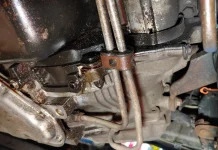
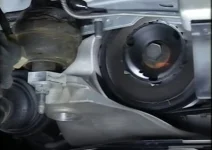
Ok, thanks, before I do that, I just want to make sure this is the area you're referring to and where you're saying I'm missing the bolt, right? IMG_9361.webp
 
Ok, thanks, before I do that, I just want to make sure this is the area you're referring to and where you're saying I'm missing the bolt, right? View attachment 44672
Yes.
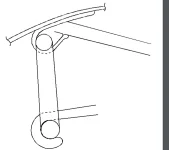
Also since we are on the topic of vibration when accelerating, can you turn your attention to your torque axis mount when on the lift. Its the one near the oil pan (there is a large bracket off the oil pan for it)

cbeb7921acbc0e2b8282f257150471cb.webp

it should look like this (near the crankshaft)

Also take a look at the trans mount near your radiator(also mounted low and near that circle in your pic) and the trans mount near your driver side wheel. Send pics if you can. There is also one on the subframe (the thing holding the engine and transmission) near the steering rack. If you send pics of them I can tell you any thoughts about them. Its a good thing to check while its in the air.
 
Back
Top