97 Buick LeSabre vacuum lines

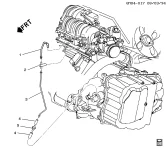
Is this the line you are referring to in the drawing. If so you may see how it is routed and if anything is not installed correctly.
940803GM04-017.webp
 
Is this the line you are referring to in the drawing. If so you may see how it is routed and if anything is not installed correctly.
Yes, number 3 and its attached bits. It doesn't appear to route that way on my engine, so that may explain it. I'll have a better look at it in bit. Thanks for the diagram, by the way!
 
Last edited:
My 95 had some questionable hoses, not knowing anything about your vehicle, assumed as such that was the reason for suggesting replacement on all. The odds are the one that didn't get done is the one that will leak tossing some type of code. Hopefully that transmission hoes will take care of the problem.
 
Do you have any idea what the item is that the line goes to?
I can't figure out what the vacuum actuator would be.
I suspect it's an input to for the transaxle to sense engine load, e.g., lower vacuum (higher manifold pressure) equates to higher engine output and thus makes it more likely to kick down a gear in order to realize higher power output.
 
I suspect it's an input to for the transaxle to sense engine load, e.g., lower vacuum (higher manifold pressure) equates to higher engine output and thus makes it more likely to kick down a gear in order to realize higher power output.
Do you have any idea what the item is that the line goes to?
I can't figure out what the vacuum actuator would be.
One end goes to the throttle body and the other end to the vacuum modulator. It controls the quality of shifts based on engine load which is measured by vacuum.
 
One end goes to the throttle body and the other end to the vacuum modulator. It controls the quality of shifts based on engine load which is measured by vacuum.
That's apparently correct because when I reconnected it it shifted into gear like I was at idle instead of flooring it during my test drive.

Incidentally, I managed to fix it by rotating the actuator a few degrees clockwise, which put the nipple in line with the vacuum line perfectly and I can probably expect it to stay put. It also improved the idle and reduced the idle speed noise dramatically to where it actually sounded and acted like it's supposed to.

Thanks to all who contributed to the discussion!
 
That's apparently correct because when I reconnected it it shifted into gear like I was at idle instead of flooring it during my test drive.

Incidentally, I managed to fix it by rotating the actuator a few degrees clockwise, which put the nipple in line with the vacuum line perfectly and I can probably expect it to stay put. It also improved the idle and reduced the idle speed noise dramatically to where it actually sounded and acted like it's supposed to.

Thanks to all who contributed to the discussion!
With these old cars a couple of feet of vacuum tubing and some various straight and tee connectors are a must.
 
______________________________

Help support this site so it can continue supporting you!
Nice troubleshooting, the best first step is a good visual exam followed by more visual exams. They used to use metal lines for long vacuum runs, now it's a hard nylon. A vacuum line can collapse if the material is too soft. Sometimes you can find barbed fittings used in garden irrigation.
 
I am tring to fix my vaccum lines coming off the intake manifold and I don't know where they go. Does anyone have a diagram for a 2001 buick centry. Thank you
 
980620MH03-015.JPG


1997 Buick Lesabre CUSTOM 4DR VAPOR CANISTER & RELATED PARTS-V6 3.8K

I'm posting this drawing just for reference.
I need the number 15 piece
 
Back
Top