Check engine light and code for thermostat-coolant temperature sensor, 3800 V6

Globetrot1

Active member
Joined
Jul 8, 2019
Messages
350
Reaction score
106
Points
43
Buick Ownership
just sold: 2008 Buick LaCrosse CX - 3800 III V6; prior car: 1992 Regal Custom coupe - 3800 I V6
The check engine light has been intermittent and it's a cooler and cold weather event. In warmer weather, it never comes on. And, sometimes, even when it's cold, it might randomly go away. This is on a first-gen LaCrosse with a 3800 Series III V6.

I have an OBD-2 reader. It's code P0128. A state emission check board published it's one of the more common failure codes on many cars ... toward the bottom of their top 10 list.

I talked to a mechanic last summer while he was doing something else for the car. He mentioned that, most of the time, the thermostat has become just a little off and the computer is so sensitive that it picks up on it. He also asked me if my temperature gauge was reading a hair lower than normal. It always does when the check engine light goes on for this code. My temp gauge is normally at 3/8 of the way up from C to H. With this situation, it's a little less than that.

The internet articles I've read say it's either the thermostat or the sensor almost all the time. It could be some grounding or something else. It was interesting that this mechanic who owns a GM car and does a lot of work on GM immediately thought this is what it could be.

Have you had this code or do you know about it? Did you change your thermostat? (In almost 12 years, mine has never been changed.) Or did you change the engine coolant temperature sensor? Or both? Was the engine temperature gauge reading a little lower than usual? No change in driving quality or fuel economy when this light is on.

Thanks.
 
It sounds like you may have a thermostat stuck partially open. I would change that first and see what happens. Since you have an OBD11 scanner, and if it is fully capable to read live data. it should show what the CTS is reading. You can compare that to the DIC temp reading to see if they match.
 
As HotZ28 says, this is very likely a sticking (open) thermostat.

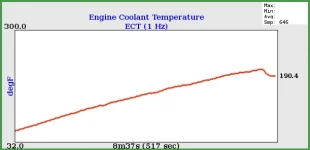
There are a couple of ways to see if the thermostat is stuck open. If you have a scantool setup that can graph, you should be able to clearly see, on a good thermostat, when the closed thermostat opens as the engine warms up -- there will be a clear dip in the ECT (Engine Coolant Temperature) when the thermostat opens at the temperature set point that it was made for. This is a graph from my post-repair work, using a new 195-degF thermostat, on a relative's 2004 Century that had this same issue, i.e. DTC (Diagnostic Trouble Code) P0128 ("Coolant Temperature Below Thermostat Regulating Temperature"), going away in hot weather, returning in cold weather:2004-Buick-Century-new-thermostat-test.webp

If the thermostat is sticking open, you won't see that dip. The engine will just warm up more slowly than it should and the ECT will rise slowly and level off.

Lacking a good graphing scantool setup, you can simply feel (or use a contact-less, IR thermometer on) the radiator hoses -- they should be relatively cool until the thermostat opens and then they get quite hot, almost too hot to handle! If there's no relatively abrupt change in the hoses' temperature (i.e. if they get hot slowly and steadily), your thermostat is probably stuck open. There should be plenty of Internet videos demonstrating this technique.

Any scantool that can monitor ECT, even without graphing it, will be useful, though. The radiator hose will get hot nearest the thermostat soon after it opens (which should happen in conjunction with the scantool's ECT report climbing above the thermostat's set point).

Incidentally, DTC P0128 is one of those that can be a "stored" DTC without actually lighting the MIL (Malfunction Indicator Lamp -- aka "Check Engine light"), so I usually remind folks to never assume that "no MIL = no DTC". It's best to scan for codes even without a lit "Check Engine" light, especially after you've seen the light once for a given problem. On the aforementioned Century, the MIL came on initially with the first appearance of P0128, but the MIL went off sometime many days afterward (probably in warmer weather), even though P0128 was still in the PCM as a "stored" DTC and stayed there until after the repair was made.

Furthermore, when I replaced the thermostat, I intentionally did not clear the PCM DTCs. I wanted to see what would happen. As I somewhat expected, the P0128 DTC disappeared on its own after 40 "cycles without an emission fault" -- basically after the car was run 40 times with no detected problems. Of course, you can clear the PCM codes with a scantool, but that will also reset a lot of things that don't need to be reset, which is one of the reasons why I tend to avoid clearing codes too hastily.

Sorry for the long-winded reply, but I hope it's useful!
 
As HotZ28 says, this is very likely a sticking (open) thermostat.

There are a couple of ways to see if the thermostat is stuck open. If you have a scantool setup that can graph, you should be able to clearly see, on a good thermostat, when the closed thermostat opens as the engine warms up -- there will be a clear dip in the ECT (Engine Coolant Temperature) when the thermostat opens at the temperature set point that it was made for. This is a graph from my post-repair work, using a new 195-degF thermostat, on a relative's 2004 Century that had this same issue, i.e. DTC (Diagnostic Trouble Code) P0128 ("Coolant Temperature Below Thermostat Regulating Temperature"), going away in hot weather, returning in cold weather:View attachment 20079

If the thermostat is sticking open, you won't see that dip. The engine will just warm up more slowly than it should and the ECT will rise slowly and level off.

Lacking a good graphing scantool setup, you can simply feel (or use a contact-less, IR thermometer on) the radiator hoses -- they should be relatively cool until the thermostat opens and then they get quite hot, almost too hot to handle! If there's no relatively abrupt change in the hoses' temperature (i.e. if they get hot slowly and steadily), your thermostat is probably stuck open. There should be plenty of Internet videos demonstrating this technique.

Incidentally, DTC P0128 is one of those that can be a "stored" DTC without actually lighting the MIL (Malfunction Indicator Lamp -- aka "Check Engine light"), so I usually remind folks to never assume that "no MIL = no DTC". It's best to scan for codes even without a lit "Check Engine" light, especially after you've seen the light once for a given problem. On the aforementioned Century, the MIL came on initially with the first appearance of P0128, but the MIL went off sometime many days afterward (probably in warmer weather), even though P0128 was still in the PCM as a "stored" DTC and stayed there until after the repair was made.

Furthermore, when I replaced the thermostat, I intentionally did not clear the PCM DTCs. I wanted to see what would happen. As I somewhat expected, the P0128 DTC disappeared on its own after 40 "cycles without an emission fault" -- basically after the car was run 40 times with no detected problems. Of course, you can clear the PCM codes with a scantool, but that will also reset a lot of things that don't need to be reset, which is one of the reasons why I tend to avoid clearing codes too hastily.

Sorry for the long-winded reply, but I hope it's useful!

The post is very helpful and that's what I thought it would be after talking to the mechanic during the summer. It just warms up very slowly. Better to have a thermostat stuck open than stuck closed!

I see no harm in changing it anyway after 12 years and almost 100,000 miles (not quite). I cannot get a degrees reading on my dashboard DIC. It's the base model. I just have a temp gauge and it moves up very slowly in winter and stays lower than in summer.

Another question - would you get your upper radiator hose changed at the same time? It's original but it looks and feels good. Also, the clamps are unusual. I'm used to the ones with screws. Or would you just change both upper and lower radiator hoses at 12 years/about 100,000 miles and then probably never mess with them again? On my '92, I don't believe I ever changed any coolant carrying hoses in 16 years. They just kept going.
 
______________________________

Help support this site so it can continue supporting you!
I see no harm in changing it anyway after 12 years and almost 100,000 miles
Completely agree. I'd change the thermostat for 2 reasons:
  1. A warmed-up engine is an efficient engine.
  2. Not having the MIL illuminate because of a P0128 DTC means that I won't inadvertently miss a different, maybe more critical, DTC that would also light the MIL.
Another question - would you get your upper radiator hose changed at the same time?
Personally, if I saw no evidence of leaking or excessive brittleness, I would not change them. But I also wouldn't 2nd-guess anyone who wanted the peace of mind of having new ones.
 
I will go visit that same mechanic right after the holidays and, if it's the thermostat, just have it changed along with the upper and lower radiator, plus clamps. The top hose will have to be unhooked and moved out of the way to work on the thermostat and its gasket, so I might as well do this all at once.

Thanks for all the good input.
 
I actually went to the mechanic a few days ago because he would be taking some time off during the holidays.

It turned out to be the thermostat. He also changed the upper radiator hose and clamps. Changing the lower hose was not seen as necessary at this time. The price was fair.

Best of all, I love driving down those stretches of highway where "all the stars aligned" and my check engine light would always come on, if it wasn't already on. That's not happening anymore. Here's hoping to a dashboard that's free of warning lights for a while.

Happy holidays, folks.
 
Back
Top