• This section is for help and assistance with 2018 and NEWER Buick Regals. If you need assistance with a 2011-2017 Buick Regal, CLICK HERE. If you need assistance with a 2010 or older Buick Regal, CLICK HERE. This notice may be dismissed by clicking the X in the right corner.
  • Car enthusiast? Join us on Cars Connected! iOS | Android | Desktop

Snow Tire Inflation Pressure?

  • Thread author Thread author G-804999
  • Start date Start date
G

G-804999

Years ago, I learned to increase the recommended pressure by 4 PSI when mounting snow tires. Is this still a thing? No mention of it in the owners manual. 235/50-18 97H Cooper snow tires. Any opinions?
 
Hmmm I had never heard of that method.

In my opinion, just run whatever pressure is listed on the tire.
 
I have never heard that. But knowing it's from "years ago" it could be out of date information with modern snow tires. I usually run in the 30-33 range and know folks that drop it even lower to spread the footprint out after a big snowfall.
 
Depends how often you check your air in the tires. I believe that was a thing of years past because not everyone would check their tire pressures throughout the winter, and with all of the temperature fluctuation you could be low very quickly.

Nowadays with all of the TPMS systems, I don't see a reason why you would want to do that. Modern snow tires do very well with dealing with the elements.
 
______________________________

Help support this site so it can continue supporting you!
85-90% of the maximum pressure listed on the sidewall. Tires today need more pressure in some cases. Years ago, tires had maximum inflation pressures of 32 psi, then it was 35, today, 44 and even 51 psi tires are common. Look at the sidewall first.
 
85-90% of the maximum pressure listed on the sidewall. Tires today need more pressure in some cases. Years ago, tires had maximum inflation pressures of 32 psi, then it was 35, today, 44 and even 51 psi tires are common. Look at the sidewall first.
No - Go by what your vehicle's door jamb sticker says NOT based on what the sidewall says.
 
No - Go by what your vehicle's door jamb sticker says NOT based on what the sidewall says.
On a fairly new car, yes. The door sticker is based on the tires that came with the car at that time. Like I said, tires have changed in the last 5-8 years. If tires that have a different maximum inflation pressure are used, the door sticker can be inaccurate. Example, my 98 Riviera door sticker says 30 psi all around. The car came with tires that had a maximum inflation pressure of 35 psi, very common at the time. About 8 years ago, I put Yokohama Avid TRX tires on it. Max inflation, 51 psi. 30 psi in them, and the car wallowed all over the place. Steering response and turn in were pathetic. I also noticed a reduction in gas mileage. Put 43 psi in them and the difference was amazing. You might think the ride was hard, but it was great.

I currently have Cooper CS-5 tires on my Riviera. Max inflation is 44 psi. I run 40 psi in them. The ride is incredible, best riding tire I have ever had on the car.

Take a look at the sidewall. If you see 44 or 51 psi max inflation, try more air pressure, and see for yourself. You can always let the air out if you find the ride objectionable. I did not, in fact the ride was great. The tire is safe to the maximum cold inflation pressure listed on the sidewall.
 
Last edited:
______________________________

Help support this site so it can continue supporting you!
Larry70, you are way off on tire pressure recommendations. Your experience with your Riv shows that the replacement tire was a poor choice, for handling. The OE tire is designed with the suspension tuning of the car in mind, among other things. Modern OE tires place strong emphasis on the car's desired purpose but fuel economy is high on the list because of CAFE.

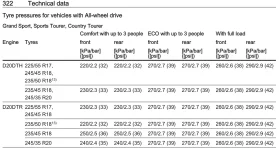
Its all about load index. Let’s use the TourX, it comes with 235/50R18 97V SL tires.

the 97 load index means it can carry a max weight, per tire, of 1,609 pounds at 51psi. If you change tire size and load index you need to adjust pressure to carry the load. The recommended pressure from GM is 32 cold, all the time(Except for >100mph sustained driving, then 36). Even when at max GVW Opel recommends 38f/42r...see here...

D3AAD3D2-6382-465E-9890-DDB144E2C4AF.jpeg

More air in the tires will increase FE(see ECO in the chart), sharpen steering response, but will ride rougher, wear out suspension components faster, and cause uneven tire wear. My summer Michelin PSS wore the center down because I ran 34psi for sharper response, 2/32” more than the edges.
 
Last edited:
Mike, I get my tire pressure recommendations from my car club director, an ASE mechanic with decades of experience. A sizeable percentage of his business involves tire replacement. You are showing me tires for a TourX, a late model car, and I would follow the tire placard inflation for a car like that, but my 98 Riviera came with tires that had a maximum inflation pressure of 35 psi, that had the same load carrying capacity as the tires that it currently rides on, just at a higher pressure. I'm giving you my real world experiences with the Cooper CS5 tires that have a maximum inflation of 44 psi. Putting 30 psi in them results in a car that wallows all over the place. Running 40 psi in them does not result in a harsh ride, and/or uneven tire wear. My car rides better than ever with the higher pressure. I've had these tires on the car for 2 years and about 20,000 miles. They are not wearing abnormally, in fact they look great. I stand by my statements. I am not way off. Fact is, anyone can try the higher pressures and be guided by their own experiences. You can always deflate the tires if you find adverse effects from the added pressure.

My 1970 GS455 Stage 1 rides on Cooper Cobra tires, also a 44 psi tire. Original tires in 1970 were Bias Ply tires. Recommended inflation pressures were 26 psi all around. I run 38 psi in the Coopers. I tried 40 psi, but the ride was a bit hard, so I settled at 38 psi. Those tires have been on the car for 4 years, and about 15,000 miles. I get compliments from passengers on how well the car rides and handles. Again, these are real world experiences.

I was skeptical as well about the higher pressures at first. I would never go back to the lower pressures. We can agree to disagree, but I stand by my recommendations for newer tires on an older car.
 
______________________________

Help support this site so it can continue supporting you!
Dear OP,
What vehicle are you asking about?
 
I've noticed that adjustments for seasonal changes seems to make improvements in ride and handling IMO.
buick.webp
 
  • Haha
Reactions: D2R
If it is the same size as the stock tires, then it should be the same at 32 psi cold at the minimum.
The winter tire compound would be softer than your stock tires and that compromised handling shall be expected.
Of course, you can compensate the softer tires by putting in a lot more air. But it is NOT recommended, as the winter tires are not for you to go racing. They are meant to get you from point A to point B in a safe manner. The article that @FavaBean quoted also states the slightly higher pressure is to help compensate the handling as part of the reasoning.
The psi printed on the side wall is the maximum pressure. Do not go anywhere close to it unless you feel like popping them. Tires warm up and the pressure increases as they are being driven.
 
Back
Top